
Human-in-the-loop is not a checkbox: How professional responsibility is truly preserved
A sign-off click is not control. Why human-in-the-loop in medical and expert-reporting processes needs more than a button at the end — and how DeepMed ReportWriter embeds professional responsibility in the workflow.
A sign-off click is not control. In medical reports, expert opinions, or administrative dossiers, the critical point is often not at the end of the process but much earlier: in the selection of what enters the draft at all, in the weighting of individual pieces of information, in the linking of findings, reasoning, and conclusions. When an AI presents a finished text, it has not only formulated. It has already sorted, condensed, omitted, and smoothed. Anyone who only reviews afterwards is no longer reviewing the raw material of professional work, but an already pre-shaped view of that raw material.
That is the blind spot of many human-in-the-loop concepts. They assume that human responsibility is preserved as long as a physician, expert, or case officer agrees at the end. This idea is convenient because it demands little technically: a button, a name under the report, perhaps a note in the log. Professionally, it is weak. Responsibility cannot be secured by placing the human at the final step of an automated workflow.
Anyone who is supposed to exercise control must see what they are deciding on. They must be able to recognise which data were used, which assumptions flowed into the draft, which uncertainties exist, and where the AI is not merely generating language but prescribing professional structure. Otherwise a strange shift occurs: the machine shapes the report, the human legitimises it.
The finished text is often already too late
Many AI applications begin with a seemingly harmless goal: from existing information, a readable report should emerge. In practice this is useful because professional processes in medicine, administration, and expert reporting genuinely suffer under documentation burden. Nobody benefits when physicians or case officers routinely rewrite the same text passages, copy tables, or manually merge scattered information.
The problem arises where support silently becomes a pre-decision. A report draft is not only a linguistic surface; it orders the world. It decides what is mentioned first, what appears relevant, what disappears as a side aspect, which causal chain seems plausible, and which alternative no longer appears at all. The better the text is written, the less visible this pre-structuring becomes.
That is why a downstream approval step is not enough. When someone receives a linguistically clean, coherent report, they usually no longer review every single inference as if they had built the report themselves from primary data. That is not moral failure, but a realistic description of professional work under time pressure. The finished text creates its own plausibility. It makes it harder to truly reopen the preceding selections.
Human-in-the-loop must therefore not begin only at the finished output. It must start where data become professional meaning.
Legal responsibility does not follow the surface
Legally, too, the difference between formal approval and genuine control is central. When an AI system is used in a sensitive process, it is not enough to point afterwards to the fact that a human confirmed the output. What matters is whether that confirmation took place under conditions that made qualified review possible at all.
Was it clear which information was used? Was there a way to correct or reject system suggestions? Were changes logged? Were the system's limits clearly defined? Was it prevented that a generative formulation appears as a professionally verified fact? Such questions are not cosmetic. They determine whether responsibility can be meaningfully assigned.
Without clean process architecture, the familiar diffusion of responsibility emerges: the operator points to the software, the vendor points to the user, the user points to the AI's suggestion. In the end someone is formally accountable, but the actual decision path is barely reconstructable. That is precisely why logging, roles, approvals, and technical purpose limits are not bureaucratic side issues, but components of responsible system design.
Control requires access to the building blocks
Genuine human control requires that the process is not designed as a black box. The professionally responsible person must be able to see not only the final report, but also the building blocks from which it was created: structured inputs, adopted free-text entries, scores, selected diagnoses, sources, system notices, uncertainties, and manual changes. Only then can it be judged whether the report holds up professionally.
That is a different standard than "AI writes, human reviews". Better would be: the system prepares information so that the human can actually decide at the decisive points. Some content may be formulated generatively. Other content should only be taken from verified fields. Still other elements must be actively confirmed, rejected, or corrected before they enter a report. The central question is not whether AI is used, but at which point it receives which degree of freedom.
Especially in medical and expert-reporting processes, this differentiation is decisive. Linguistic smoothing is something different from a diagnosis, and a summary of existing information is something different from a professional assessment. A robust system must reflect such differences not only in staff training, but in the workflow itself.
The ReportWriter example
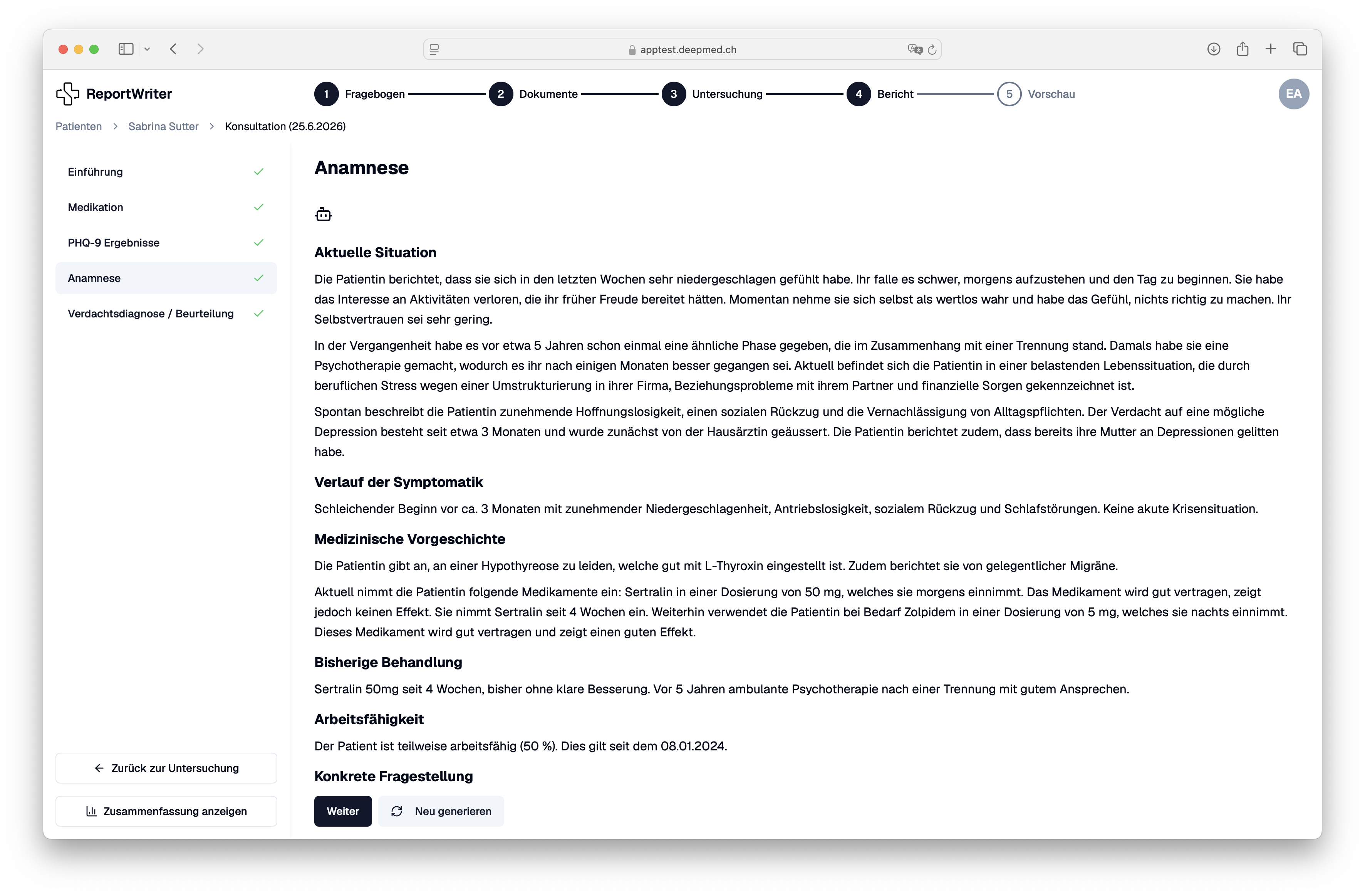
In DeepMed's ReportWriter, the process does not begin with an empty chat window or with the request to generate the most convincing report possible from unstructured notes. The starting point is a structured input mask developed professionally with the customer. It reflects the respective history-taking, assessment, or consultation process: with questionnaire elements, physician inputs, selection fields, scores, progress data, and, where appropriate, additional free-text fields for notes.
This structure is not only user interface, but also a professional model of the work process. Together with the customer, it is defined which information must be collected, which entries are optional, which fields depend on one another, and which content may later flow into the report. In this way, part of quality assurance is shifted forward from downstream reading of the finished text into the collection and structuring of information.
The AI is then not simply given the task of "writing a report". It receives structured inputs and a precise rule for how a specific report section is to be created from those inputs. It may, for example, linguistically condense a history, merge information from different fields, or bring a section into the desired professional tone. The AI's scope is thereby narrowed: it does not work freely across a dossier, but within a defined report step, with defined inputs and a clearly described writing task.
For especially sensitive professional content, this scope is further limited or excluded entirely. Diagnoses, medications, or other central medical information are not invented, decided, or freely interpreted by the AI. They are selected or entered by the physician and then adopted into the report deterministically — that is, rule-based and predictably. Where content should not be variably interpreted, it is not generated generatively either.
This difference is essential. A system that derives a diagnosis from notes and writes it into a finished report creates a different responsibility structure than a system in which the physician selects the diagnosis and the software correctly adopts it at the intended place. In the first case, professional decision and linguistic formulation run together. In the second case, it remains visible which part was decided medically, which part was captured in structured form, and which part was linguistically supported.
Free-text fields do not change this, as long as they are correctly positioned. Notes can be important because professional work does not fit entirely into selection fields. But they must not cause the entire process to fall back into uncontrolled text generation. What matters is whether it remains clear which information comes from structured fields, which was summarised from notes, and which elements must be actively confirmed.
It is precisely at such points that it becomes clear whether human-in-the-loop is meant seriously. Not in the claim that the human "has control" at the end, but in the concrete architecture of the workflow: which information is collected in structured form? which decisions must be made by the physician? which content may the AI formulate? which content is adopted deterministically? which steps are traceable? and where does the system's permissible scope end?
ReportWriter therefore uses AI not as a substitute for professional assessment, but as a tool within a professionally designed process. The AI does not write from nothing. It processes verified or deliberately entered information according to defined rules. That is less spectacular than a chatbot that produces a complete report at the push of a button. For sensitive professional processes, it is the more robust approach.
Professional responsibility is a process question
Professional responsibility is not an abstract property of a person who signs a document at the end. It arises in the interplay of role, information, ability to intervene, and documentation. Anyone who is to be responsible needs a working environment in which they can recognise and influence the decisive points.
This concerns roles first. It must be clear who captures data, who confirms professional information, who adopts system-generated suggestions, and who releases the report. But it also concerns the system's limits. An AI that gives completeness hints has a different function than an AI that suggests professional conclusions. Software that generates text blocks from verified inputs is assessed differently from a chatbot that formulates a recommendation from a dossier.
Even more important is documentation. In sensitive professional processes, it must later be traceable which information came from structured data, which was extracted from free text, which passage was created generatively, and which change the human made. Without this separation, responsibility blurs precisely where it later becomes relevant: in follow-up questions, complaints, liability cases, audits, or professional corrections.
A good human-in-the-loop process therefore protects not only against errors, but also against the retrospective uncertainty of how an error arose.
Why chatbots are not enough
A chat window can be helpful. It can explain, summarise, rephrase, organise ideas. For many tasks that is sufficient. For regulated or professionally sensitive processes, however, it is often too little, because chat does not reliably control the structure of the work process.
In chat, input, analysis, draft, and decision blur together. The user asks, the system answers, the user copies, corrects, shortens. That can work well in individual cases, but it is hard to audit. Which basis was actually used? Which information was overlooked? Which passage is system interpretation, which is a secured finding? Why was one suggestion adopted and another not? Such questions can only be laboriously reconstructed in a free dialogue flow.
Professional workflows therefore need more than good model quality. They need structured inputs, defined intermediate steps, separated areas of responsibility, technical limits, and traceable outputs. The value lies not only in the language model, but in the architecture around the language model.
That is also why a platform like DeepMed does not stop at text generation. Document analysis, plausibility checks, structured masks, deterministic report sections, AI-supported summaries, and logging are not add-on features at the margin. They are the prerequisite for AI in professional processes not only to impress, but to deliver robust results.
Good AI limits itself
In many debates, AI is still measured by how far it can replace humans. For sensitive professional processes, that is the wrong standard. There, a system is not good because it appears as autonomous as possible, but because it enforces the right division of labour.
AI may relieve burden. It may pre-structure information, mark contradictions, prepare text drafts, and point to gaps. But it must not shift professional responsibility unnoticed. Where a system creates the impression that it only formulated, although in truth it weighted and decided, it becomes dangerous.
The better systems will therefore not necessarily be those that write most spectacularly. They will be those that clearly map their own limits: through structured fields, deterministic adoption, active confirmations, logs, escalation rules, and a clear separation between hint, draft, and decision.
Human-in-the-loop is thus not a user interaction at the end of an automated process. It is an architecture decision. Anyone who wants to preserve professional responsibility must build the workflow so that the human does not only sign, but can actually decide.
For medicine, administration, expert reporting, and compliance, that is the decisive line. AI will not be measured there by whether it writes as human-like as possible. It will be measured by whether it eases professional work without blurring responsibility. It is at exactly this boundary that it is decided whether AI remains a tool — or becomes the invisible instance in professional decision-making.
Want to see what human-in-the-loop looks like in practice? Book a demo and we will walk you through the ReportWriter workflow.
Editorial note: This article was prepared with reference to current sources on AI governance, liability, and human oversight, including the EU AI Act, the NIST AI Risk Management Framework, and international standards such as ISO/IEC 42001 and ISO/IEC 23894. Practical experience from DeepMed projects on controlled report creation, plausibility checking, and human-in-the-loop workflows was also incorporated.
Want to see DeepMed in action?
More articles
AI in healthcare: The real risk is shadow use
The question is no longer whether AI is used in healthcare, but where. When staff turn to public tools, shadow use emerges — with uncontrollable risks for data protection and professional secrecy.
Read articleAmbient AI Scribes in Clinical Documentation: Insights from npj Digital Medicine
A new npj Digital Medicine perspective on scaling ambient AI scribes — and how DeepMed ReportWriter helps turn transcription into responsible, structured clinical documentation.
Read article