
Ambient AI Scribes in Clinical Documentation: Insights from npj Digital Medicine
A new npj Digital Medicine perspective on scaling ambient AI scribes — and how DeepMed ReportWriter helps turn transcription into responsible, structured clinical documentation.
A perspective article published in npj Digital Medicine on 23 March 2026, “Barriers and opportunities of scaling ambient AI scribes for clinical documentation across diverse healthcare settings”, analyses ambient AI scribes: tools that use large language models to transcribe, summarise, and structure patient-clinician conversations in real time.
The authors highlight both the transformative potential and the significant hurdles of deploying these technologies beyond initial low-acuity ambulatory settings. For DeepMed Zurich AG, which develops Swiss-hosted AI solutions for clinical documentation, the paper offers valuable validation and a clear roadmap.
The promise of ambient AI scribes
Ambient AI scribes aim to solve one of healthcare’s most persistent problems: the heavy administrative burden of clinical documentation. Studies cited in the article show:
- Median reductions in EHR time of up to 5.6 minutes per appointment in specialty practices.
- Decreased clinician burnout, mental effort, and cognitive load.
- Improved patient engagement and perceived visit quality (84% of clinicians and 56% of patients reported positive effects).
These tools free clinicians from after-hours documentation and allow more focus on patient care. Benefits appear consistent for clinician well-being, even when raw time savings vary.
However, the article stresses that success is highly context-dependent. Performance differs across primary care, high-acuity settings (EDs, ICUs), pre-hospital care, virtual consultations, and low-resource environments. Challenges include audio quality in noisy settings, speaker differentiation, EHR interoperability, note bloat, privacy risks, bias, and the lack of proven impact on hard clinical outcomes.
How DeepMed ReportWriter addresses these challenges
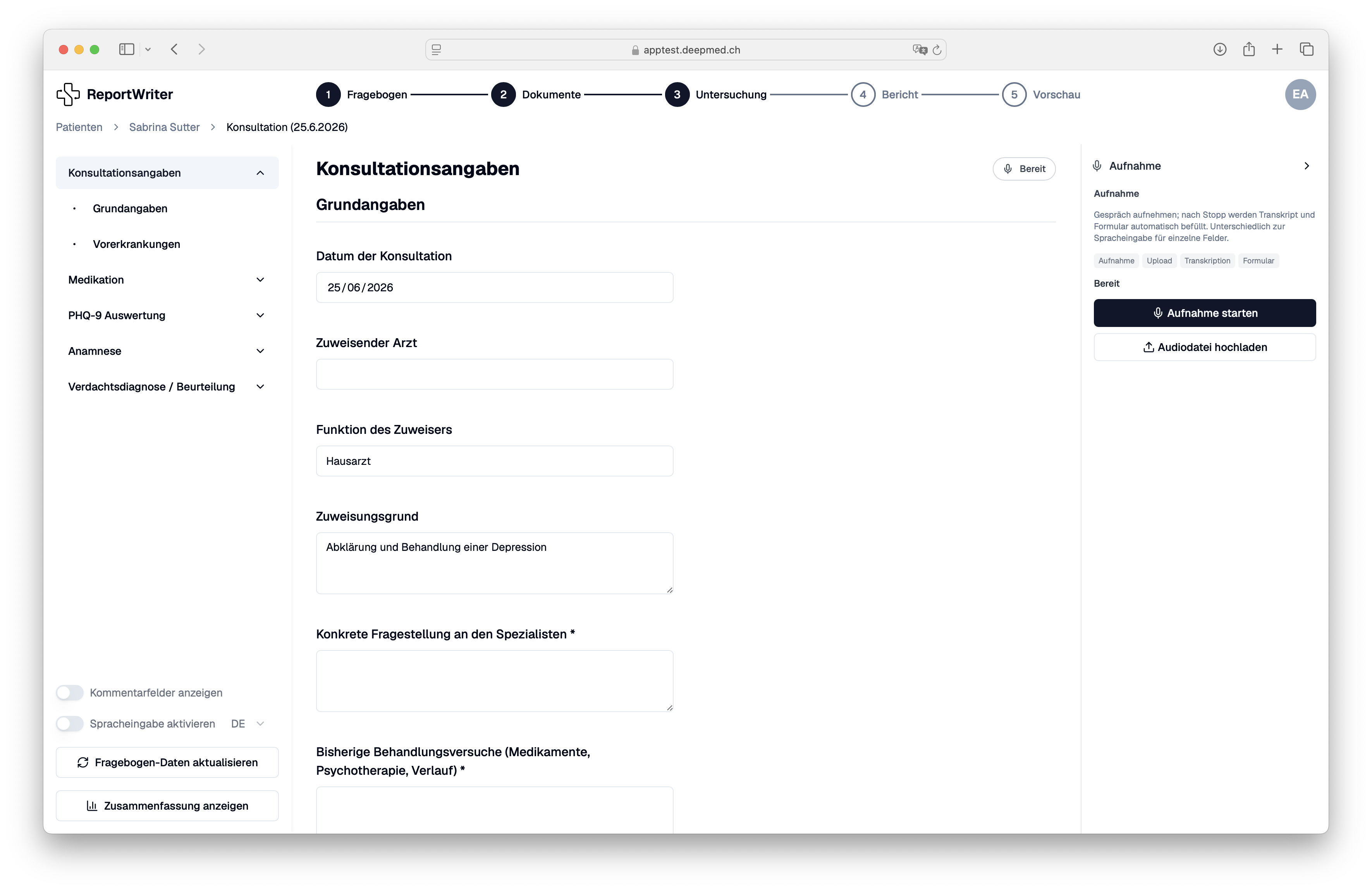
DeepMed’s ReportWriter is designed for the structured, high-stakes documentation needs that ambient scribes feed into. While ambient scribes excel at real-time transcription and initial summarisation, turning raw conversation into accurate, concise, and clinically actionable reports requires specialised capabilities.
ReportWriter bridges this gap with:
- Structured, template-driven generation — Mandatory fields, rule-based logic, and deterministic transfer of critical content help prevent note bloat and ensure completeness and traceability.
- VoiceControl and transcription integration — Supports ambient-style workflows while maintaining clinician oversight and editability.
- High accuracy and consistency — Reduces post-generation editing burden, a critical factor for adoption and safety.
- Swiss-hosted privacy and sovereignty — In our Swiss cloud configuration, productive customer data is stored and regularly processed in Switzerland, with encryption, granular access controls, and no reuse of customer data for model training. This aligns with European regulatory expectations, including considerations around the EU Medical Device Regulation.
- Clinical-grade quality controls — Discrepancy flagging, context-aware summarisation, and support for prior history integration help move beyond passive transcription toward assistive intelligence.
These features make DeepMed well-suited for scaling ambient documentation solutions responsibly across diverse Swiss and European healthcare settings, from outpatient psychiatry and psychotherapy practices (where documentation of conversations is central) to hospital environments requiring structured reports for teams, referrers, and insurers.
Opportunities for broader impact
The paper identifies strong potential in:
- Primary care and specialties with high documentation loads.
- Multilingual and linguistically diverse environments, relevant for Switzerland’s multilingual context.
- Settings facing workforce shortages, where tools can amplify existing clinical capacity.
DeepMed’s Swiss roots and focus on practical clinical integration position it well to deliver these benefits locally while contributing to the international evidence base the article calls for: domain-specific benchmarks, real-world validation studies, and governance frameworks.
Responsible scaling is key
The authors correctly emphasise that technical sophistication alone is insufficient. Success requires:
- Contextual validation across settings.
- Inclusive design that addresses bias and equity.
- Robust governance around consent, liability, data retention, and clinician oversight.
- Ongoing monitoring of edit burden, documentation quality, and subgroup performance.
DeepMed’s approach keeps the clinician firmly in the loop as the final approver, prioritises deterministic and auditable outputs, and maintains Swiss data control. That embodies this responsible stance.
Looking ahead
Ambient AI scribes and structured report automation are complementary technologies. Together, they represent a powerful lever for reducing administrative burden, improving clinician well-being, enhancing patient interactions, and supporting better care continuity.
At DeepMed Zurich AG, we contribute to this evolution with solutions like ReportWriter that turn promising AI capabilities into reliable, privacy-respecting tools tailored for real clinical workflows.
Book a demo to explore how DeepMed can support your documentation processes, or contact us at contact@deepmed.ch.
Reference: Ke Y, Liu N, et al. Barriers and opportunities of scaling ambient AI scribes for clinical documentation across diverse healthcare settings. npj Digit Med. 2026. https://doi.org/10.1038/s41746-026-02554-0
Want to see DeepMed in action?
More articles
AI in healthcare: The real risk is shadow use
The question is no longer whether AI is used in healthcare, but where. When staff turn to public tools, shadow use emerges — with uncontrollable risks for data protection and professional secrecy.
Read articleHuman-in-the-loop is not a checkbox: How professional responsibility is truly preserved
A sign-off click is not control. Why human-in-the-loop in medical and expert-reporting processes needs more than a button at the end — and how DeepMed ReportWriter embeds professional responsibility in the workflow.
Read article